SAP TechEd 2026 (part 1): BDC, Datasphere, SAC and BW with Joule
What SAP announced at TechEd 2026 for BDC (Dremio, data products from Joule Studio), Datasphere, SAC and BW/4HANA, and what Joule changes for BI teams.
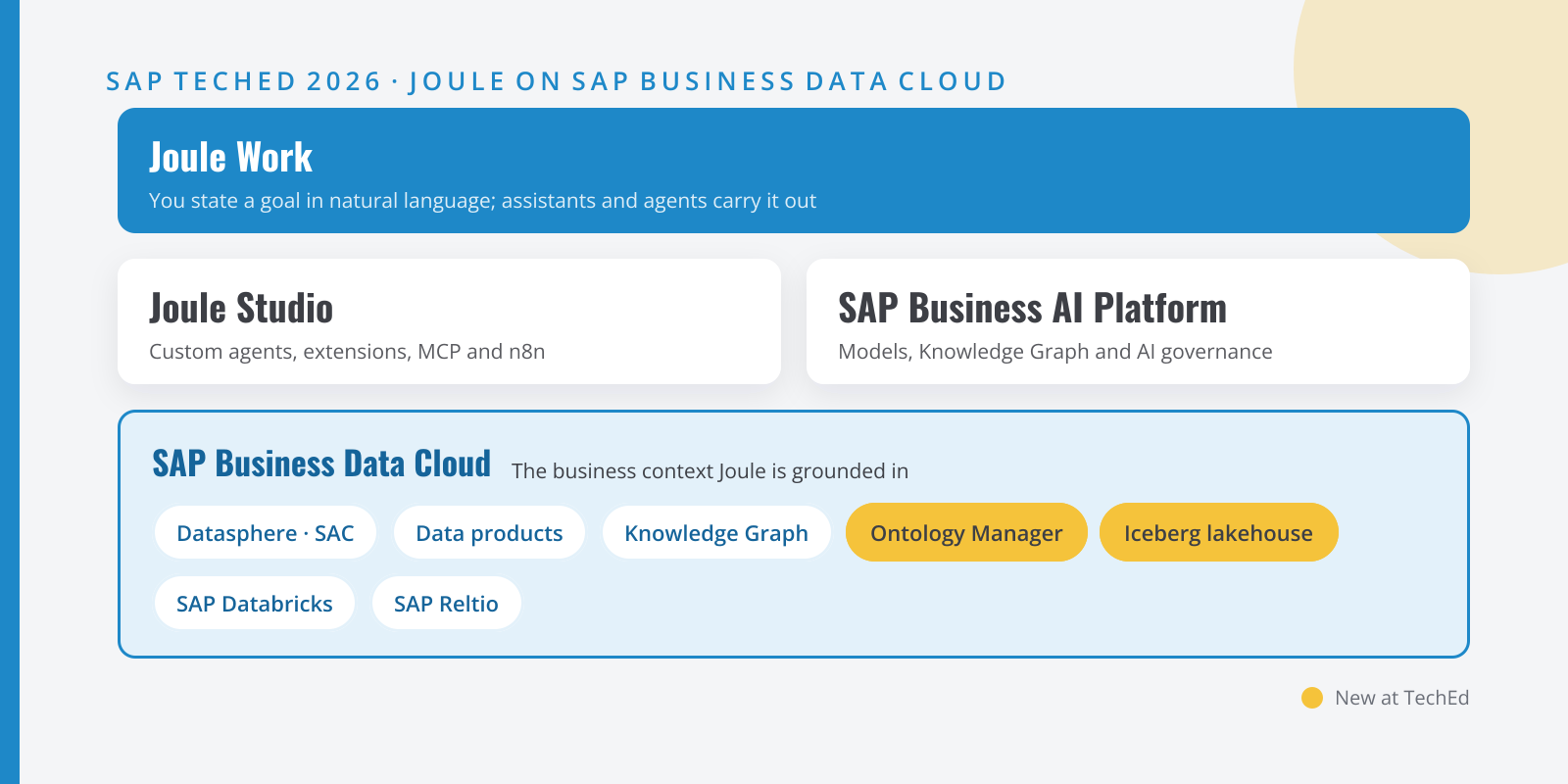
Table of contents
From 27 to 29 October 2026, SAP held SAP TechEd in Berlin and online. There was one message: Joule. Joule Work as the way to work, Joule Studio to build agents and SAP Business AI Platform underneath it all. For those of us in BI, the interesting part is the role SAP gives to SAP Business Data Cloud (BDC): the business context Joule relies on so it doesn’t make answers up. I went through the official announcements and that week’s product blogs and split them into two parts. This first part covers what affects BDC, Datasphere, SAC and BW/4HANA, with the status of each item. In part 2 I cover the ABAP news and the free training SAP has opened until December.
SAP Business Data Cloud: the context Joule relies on
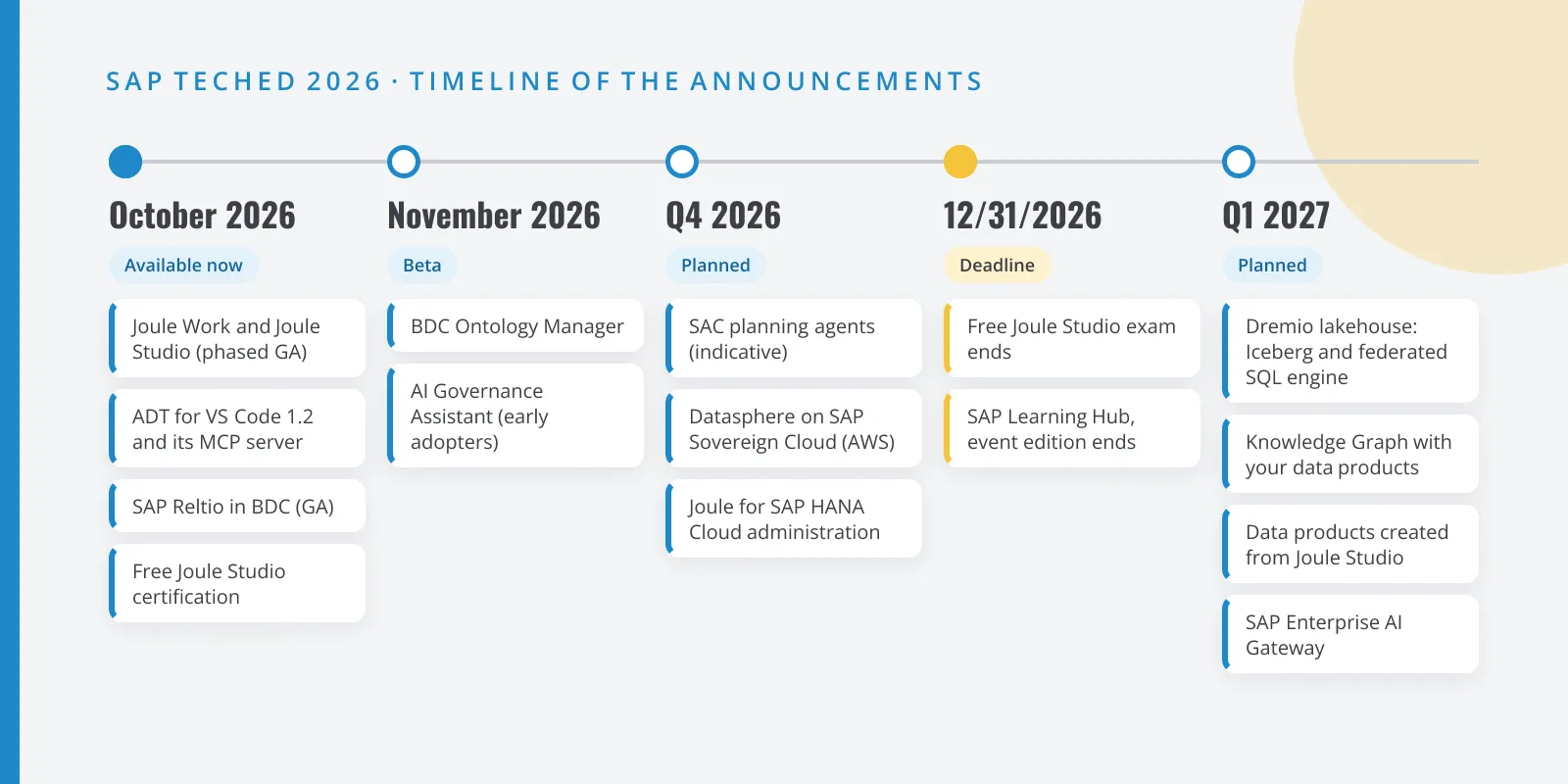
SAP calls BDC the grounding engine of the autonomous enterprise. In other words, when a Joule agent answers a question about sales or collections, it should do so from governed data products and their semantics, not from what the model thinks it knows. These are the announcements, with the status SAP gives in its news guide:
| Announcement | What it brings | Status |
|---|---|---|
| Open lakehouse with Dremio | Native Apache Iceberg, a catalog based on Apache Polaris integrated with the BDC catalog, and a federated SQL engine that queries without copying data (SQL Server, Oracle, Postgres, MongoDB…) | GA planned for Q1 2027 |
| Data products from Joule Studio | Create and consume BDC data products from Joule Studio, and give agents runtime access within the controls IT already defines | GA planned for Q1 2027 |
| SAP BDC Ontology Manager | Domain views of SAP Knowledge Graph (for example, collections: customers, invoices, payment terms, credit risk), so each agent gets only the context it needs | Beta in November 2026 |
| SAP Knowledge Graph with customer data | Takes in SAP-managed data products and your own BDC data products, not just SAP reference models | GA planned for Q1 2027 |
| Expanded SAP Databricks | Lakeflow, Agent Bricks, Unity Gateway and Lakebase, the new SAP Application Data Foundation, and a Joule–Genie integration | Announced; the guide gives no date |
| SAP Reltio | Multi-domain master data management inside BDC, with AI-based entity resolution | GA in BDC; its data products in Q1 2027 |
My consultant’s reading: almost everything that touches BDC is an announcement dated 2027 or a beta. What is available now is the Joule layer (Joule Work, Joule Studio and the agent gateway, in phased GA) and SAP Reltio.
Dremio: BDC’s open lakehouse
This is the announcement with the biggest impact on data architecture. SAP announced the acquisition of Dremio on 4 May 2026 and closed it on 6 July. At TechEd it explained what Dremio will bring to BDC:
- Iceberg as a native format. BDC already supported Delta Lake and now adds Apache Iceberg. In the acquisition release, SAP even speaks of an “Iceberg-native” BDC, where SAP and non-SAP data coexist in the same open format with no conversion.
- A universal catalog based on Apache Polaris and the Iceberg REST Catalog API, integrated with the BDC catalog. SAP presents it as BDC’s discovery and semantic layer and as the foundation of SAP Knowledge Graph: meaning, relationships, access rights and lineage in a single point of access for any engine, SAP or not.
- A federated SQL engine that queries lakehouses and relational databases without moving data, with natural-language access from Joule Work.
- Reflections. Dremio learns how data is queried, automatically precomputes and optimizes the results, and adapts as workloads change. SAP pitches it as an alternative to hand-maintained summary tables, materialized views or BI extracts.
- Serverless and elastic: it scales up on demand peaks and back down again, with no fixed capacity to size. SAP positions it as a complement to SAP HANA Cloud’s in-memory engine, which remains the piece for transactional and real-time workloads.
For a team that persists views in Datasphere today so that SAC runs fast, Reflections are the most interesting part. But all of this has GA planned for Q1 2027. Before redesigning anything, I would ask SAP three things: how the Dremio engine will coexist with Datasphere’s persisted views and replicas, whether it will consume separate capacity in BDC, and what happens to authorizations (DACs) when a federated query spans SAP and non-SAP sources.
Data products created from Joule Studio
The official guide puts it this way: development teams will be able to create and access BDC data products directly within Joule Studio. Customers will also be able to give agents runtime access to that data, always within the controls IT has already authorized. SAP describes it as automating what used to be a manual process. GA is planned for Q1 2027.
It fits the intent-based development shown in the keynote. You describe what you want, and Joule Studio, backed by SAP Knowledge Graph, SAP LeanIX, SAP Signavio and the SAP Domain Models, finds the relevant APIs, MCP servers and data products and generates the agent’s specification and structure. For BI, the consequence is clear: a data product is no longer something only the data team models; it also becomes something an agent developer requests and consumes. That makes data product governance (requests, data stewards, access agreements) even more important.
Ontology Manager, Knowledge Graph, Databricks and Reltio
- SAP BDC Ontology Manager (beta in November): AI-assisted creation of domain views of the Knowledge Graph, using SAP and customer data products, which can be reused in other use cases to save time and tokens.
- Knowledge Graph with your data: until now it was fed by specific SAP applications. It will take in customer BDC data products and data from SAP Autonomous Suite extensions. Our models become context for Joule.
- SAP Databricks: SAP says the full scope of the Databricks platform will be available natively in BDC. With SAP Application Data Foundation, data from SAP applications can be consumed in the BDC engine of your choice, SAP Databricks included, and shared without copies through BDC Connect.
- SAP Reltio: available now in BDC. It unifies customers, suppliers and products across SAP and non-SAP systems. It will be able to build unified data products (Q1 2027) and, together with SAP Master Data Governance in BDC, strengthens master data management inside the platform.
SAP Datasphere: sovereignty, wave 2026.22 and Joule
In the keynote, Datasphere features in a single announcement: SAP Sovereign Cloud on AWS will add SAP Datasphere, SAP AI Core and Joule, with GA planned for Q4 2026 in the United Kingdom, Australia and Canada. It is aimed at regulated industries (public sector, banking, healthcare, defense).
The week before, on 20 October, wave 2026.22 arrived. The most useful items for a BI team:
- The Data Pipeline Analyzer shows the affected SAC stories when an analytic model or exposed view fails. You can finally see the business impact from one place. I covered this tool in the post on AI in Datasphere and the Data Pipeline Analyzer.
- Expression Evaluator task in task chains: evaluates expressions with input and output parameters and reuses them in later tasks, enabling more dynamic chains.
- Custom connections to external REST APIs to load JSON into the object store with replication flows (file spaces only).
- AI SQL generation in transformation flows on file, with CTE support.
- A graphical task chain monitor, release states for views in the catalog and no more 100-space limit per user in scoped roles.
- System mappings so that transports connect to the right data products, which I explained in the post on system mappings and transports in BDC.
On Joule in Datasphere, a SAP Community blog from 22 October is a useful reminder of two things. First, it isn’t switched on by default: you have to enable it at tenant level and assign the privilege to users. Second, not everything costs the same. In the Discovery Center catalog, SQL Generation is Base, with no AI Units, but Semantic Generation (assigning semantic types to non-SAP data) is Premium and does consume AI Units.
SAP Analytics Cloud: AI features and planning agents
The keynote had no specific SAC announcement, but there was news during TechEd week. On 26 October, in its Q3 AI release highlights, SAP declared two features generally available, both classified as Base in Discovery Center, with no AI Units:
- Prompt Insights: the story designer adds a widget with an LLM prompt, and users get an analysis of the table or answers without moving data to external tools.
- Story Code Generation: generates the JavaScript for story scripts and explains what each part does.
They are joined by Metrics Trend Analysis, also Base, which summarizes the evolution of metrics in natural language in email report subscriptions.
The most relevant news for planning is the SAC planning agents. A SAP blog from 23 October publishes this indicative timeline, which is not a GA commitment:
| Agent | Purpose | Indicative timing |
|---|---|---|
| Enterprise Planning & Simulation Agent | Planning activities and scenario exploration | Q4 2026 |
| Data Action Design Agent | Designing the calculation logic of planning processes | Q4 2026 |
| Analytics & Planning Model Creation Agent | Translating requirements into model structures | Q4 2026 |
| Data & Analytics Insights Agent | Creating analytical experiences and insights | Q4 2026 |
| Analytics Narrative Agent | Turning findings into a business narrative | Q4 2026 |
| Plan Data Upload Agent | Bringing planning inputs into the planning environment | Q1 2027 |
The Data Action Design Agent interests me most: designing data actions is one of the most time-consuming parts of a planning project (we saw it in the hands-on on data actions with story filters). But an agent that proposes calculation logic doesn’t replace the person who validates it against the business. The blog itself stresses human oversight.
SAP BW/4HANA: no announcements, but a message
There was no BW/4HANA news at TechEd. The message came another way. In an SAP Learning live session on 20 October, published as questions and answers on the 22nd, SAP recommends:
- A phased approach: first a lift & shift of BW 7.5 to SAP BW/4HANA on the Private Cloud Edition (PCE), which is low-risk and preserves your models. Then move objects selectively to Datasphere with the modernization tools, such as the data product generators.
- No direct greenfield jump from BW 7.5 to Datasphere, because the tooling is not mature enough for that path yet.
- Not betting on BW Bridge, given its limitations compared with BDC and BW on PCE.
- Migrating by domain (Finance first, then HR, Procurement…) rather than everything at once.
I covered this in detail in BW NetWeaver in BDC beyond 2030 and in the Query Template Generator. What TechEd adds is one more reason: if the Knowledge Graph will take in customer data products, BW data published as data products could become context for Joule. That is my reading; SAP has not announced it specifically for BW.
What Joule changes for a BI team
If Joule Work becomes the front door, many people will stop opening a story to ask “how are sales this quarter?”. They will ask Joule. And Joule will answer with whatever it finds in data products, the Knowledge Graph and its domain views. That shifts our priorities:
- The semantic layer is the contract. Descriptions, measure names, hierarchies and texts stop being optional documentation: they are what the agent reads. An Analytic Model with poorly described measures will produce confusing answers.
- Your own data products matter more. If the Knowledge Graph takes in customer BDC data products and Joule Studio can create them, our models become context for Joule. Publish them with the same rigor as SAP’s.
- Authorizations travel with the data. SAP stresses that agents access data “within the controls already established”. In practice, the DACs and access agreements that protect a story today will also protect an agent’s answer. Review them.
- A new job appears: modeling ontologies. The Ontology Manager is squarely a data architect’s task: deciding which entities and relationships each agent sees.
- Watch the cost. Some features are Base and others consume AI Units (Semantic Generation, for example). Before enabling anything, check each feature in Discovery Center.
My recommendation
For a BI team, TechEd 2026 doesn’t change tomorrow’s work, but it does show where things are heading. I would do three things this quarter:
- Review the semantic quality of your most-used Analytic Models and data products: descriptions, texts and authorizations.
- Put the Q1 2027 dates (Dremio lakehouse, Knowledge Graph with your own data, data products from Joule Studio) and the SAC planning agents on the roadmap, and confirm them with SAP before committing to anything.
- Take the free Joule Studio certification, which I explain in part 2: it’s the cheapest way to understand how an agent consumes, and will soon create, our data products.
Sources
- SAP Empowers AI Developers to Build What Matters and Turn Intent into Autonomous Execution (SAP News, press release, 27/10/2026)
- SAP TechEd 2026 Innovation News Guide (SAP)
- Advancing SAP Lakehouse and New Data Fabric Innovations in SAP Business Data Cloud (SAP News, 29/10/2026)
- SAP TechEd in 2026: SAP Tells Developers “You Can Build the Autonomous Enterprise” (SAP News, 28/10/2026)
- SAP to Acquire Dremio to Unify SAP and Non-SAP Data to Power Agentic AI (SAP News, 04/05/2026)
- SAP Completes Acquisition of Dremio (SAP News, 06/07/2026)
- AI Release Highlights Q3 2026 (SAP News, 26/10/2026)
- What’s New in SAP Datasphere, wave 2026.22 (SAP Help)
- Did You Know? Joule for Datasphere (SAP Community, 22/10/2026)
- From static plans to a “planning brain”: how SAP planning agents can reshape Enterprise Planning (SAP Community, 23/10/2026)
- Choosing an SAP BW Modernization Strategy — Your Questions Answered (SAP Community, 22/10/2026)
- Prompt Insights (SAP Discovery Center, AI catalog)
- Story Code Generation (SAP Discovery Center, AI catalog)
- Metrics Trend Analysis (SAP Discovery Center, AI catalog)
- SQL Generation in SAP Datasphere (SAP Discovery Center, AI catalog)
- Semantic Generation in SAP Datasphere (SAP Discovery Center, AI catalog)